


A motor start capacitor delivers a burst of torque to spin up a single-phase motor from standstill. It stores energy, releases it to create a phase shift that helps the start winding pull the rotor around, and disconnects via a centrifugal switch or relay once the motor reaches 70 to 80 percent of rated speed. After that, the motor runs on its main winding and the capacitor sits idle. Without one, the motor typically hums, overheats, and trips instead of turning.
Typical applications
Any piece of equipment that uses a single-phase motor and needs a strong kick to get moving probably relies on a motor start capacitor. Air compressors start against cylinder pressure. Submersible well pumps fight the inertia of the water column and the pump rotor. Table saws and workshop machinery accelerate heavy blades and belts. Refrigeration and air conditioning compressors start against the pressure differential across the system. Farm equipment augers, grain conveyors, feed mixers calls on start capacitors every cold morning when oil is thick and loads are stiff. In every case, the capacitor delivers a short, powerful torque pulse and then drops out, protecting the start winding from prolonged current that it was never designed to handle continuously.
Key specifications for replacement
A motor start capacitor is a service item. When it fails, the motor either refuses to start or struggles to reach speed while making a loud hum. Replacing one correctly means matching a few critical values.
●Capacitance (µF or MFD):The most critical number. It sets the energy delivered per start cycle. Match the original within ±20 percent tolerance. Too high pushes excess current through the start winding; too low fails to spin the load.
●Voltage rating:Common values are 125V, 165V, 250V, and 330V AC. The replacement must meet or exceed the original. The capacitor sees line voltage plus back EMF, so higher is safe never go lower.
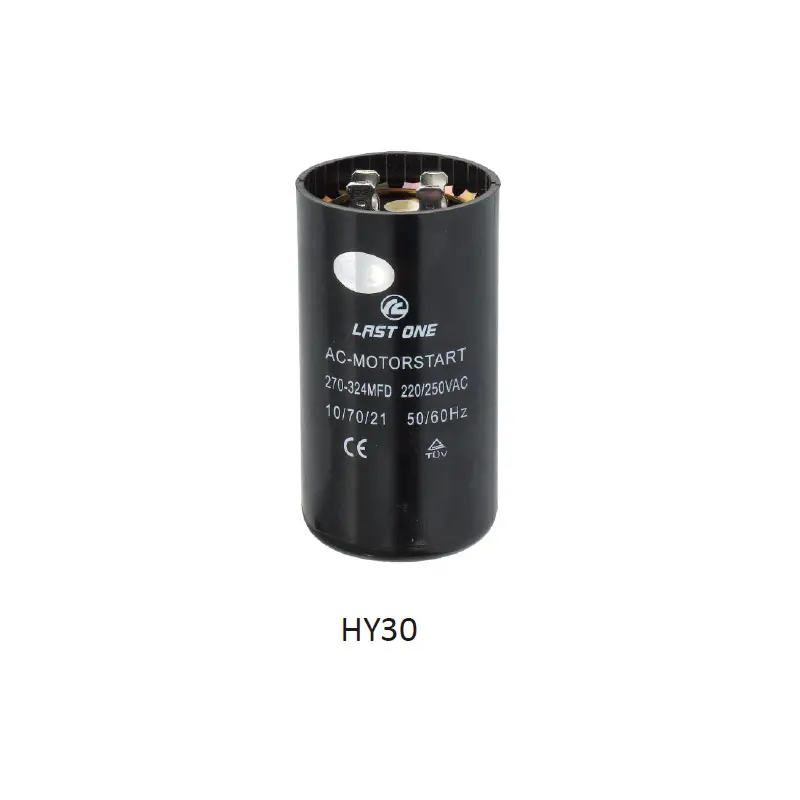
●Physical dimensions:Start capacitors are cylindrical, usually black or dark brown plastic, with a threaded stud or strap bracket. Measure body diameter and length before ordering. Note the terminal type blade, screw, or wire lead so it connects without modification.
How a start capacitor differs from a run capacitor
Confusing the two leads to a quick failure. A motor start capacitor works in short bursts and disconnects after startup. It uses a non-polarized electrolytic design that packs high capacitance into a small package but cannot handle continuous duty. A run capacitor stays in the circuit all the time, continuously adjusting the phase relationship during operation. It uses an oil-filled or dry film construction rated for continuous voltage. Installing a start capacitor in a run application will cause it to overheat, vent, and fail sometimes within minutes. If the capacitor has a duty cycle printed on its label or datasheet, pay attention to it.
Common failure signs and causes
Start capacitors fail in predictable ways. A motor that hums but won’t rotate is the most obvious sign. A capacitor with reduced capacitance may let the motor start with a manual spin but not on its own. A bulged or split case signals internal pressure from overheating. An open reading on a multimeter means a broken internal connection; a shorted reading indicates failed dielectric.
Common causes include aging electrolytic capacitors dry out over years along with rapid cycling without cooling intervals. Low line voltage forces higher starting current, stressing the capacitor. A stuck centrifugal switch that fails to disconnect after startup destroys the capacitor quickly by forcing continuous current through a device built for intermittent duty.
Choosing a replacement without the original part in hand
Service technicians often face a motor with an unreadable capacitor label or a unit that someone already removed. In that situation, the motor nameplate can provide guidance. Look for a listing that says “start capacitor” or “start cap” followed by the µF and voltage values. If the nameplate only provides a part number, contact the motor manufacturer with the model and serial number to request the capacitor specification. A generic replacement is available for most common fractional-horsepower and single-phase motors up to about five horsepower, as long as the capacitance and voltage match. Avoid the temptation to guess capacitance value errors damage the start winding over time even if the motor appears to start.
FAQ
Q: Can I use a higher MFD capacitor than the original?
A: It is not recommended. A higher capacitance increases starting current through the start winding beyond the design limit, which shortens winding life. Stick within the specified tolerance.
Q: Can I use a start capacitor in place of a run capacitor?
A: No. Start capacitors are rated for intermittent duty only. If left in circuit continuously, they will overheat and fail. Run capacitors are designed for continuous operation.
Q: What does a start capacitor look like when it fails?
A: Common visual signs are a bulging or split plastic case, dark discoloration near the terminals, or oily residue around the vent plug. Some capacitors fail electrically without visual clues; a capacitance meter or a multimeter with capacitance range is the only way to confirm.
Practical buying advice
For maintenance buyers and service technicians, keeping a small truck stock of common start capacitor ratings like 108-130 µF and 250-330 µF at 250V covers most single-phase motors in well pumps, compressors, and small industrial gear. Match the mounting style so the replacement fits without modifying the enclosure.
When ordering online, pull the failed capacitor, photograph the label for µF, voltage, and dimensions, and search for those exact values. Price gaps between generic and recognized brands are modest, so pick a supplier that provides a datasheet with tolerance, duty cycle, and temperature range. Fresh stock matters with electrolytic components a capacitor sitting on a shelf for years may have aged out before ever being installed.
Long after the purchase, a correctly chosen motor start capacitor does its job in seconds and rests for hours. The compressor, pump, or saw gets the credit, but the capacitor made the first fraction of a turn possible.
Post time: May-20-2026