


A start capacitor provides the extra torque needed to start a single-phase motor. This guide covers how it works, how to select the correct microfarad (µF) and voltage rating, common failure symptoms, and safe replacement steps for air conditioners, compressors, pumps and refrigeration equipment.
What Does a Start Capacitor Do?
A start capacitor is connected in series with the start winding of a single-phase motor during startup. Single-phase motors do not produce a rotating magnetic field on their own, so the capacitor creates a phase shift between the start and run windings. This phase difference generates the torque needed to overcome the inertia of the rotor and load.
Once the motor reaches approximately 70–80% of its rated speed, the start capacitor is disconnected from the circuit by a centrifugal switch, a potential relay, or a current relay. If it remains in the circuit, it overheats and fails. The run winding and, in CSCR motors, a separate run capacitor continue to operate during normal running.
Construction and Case Type
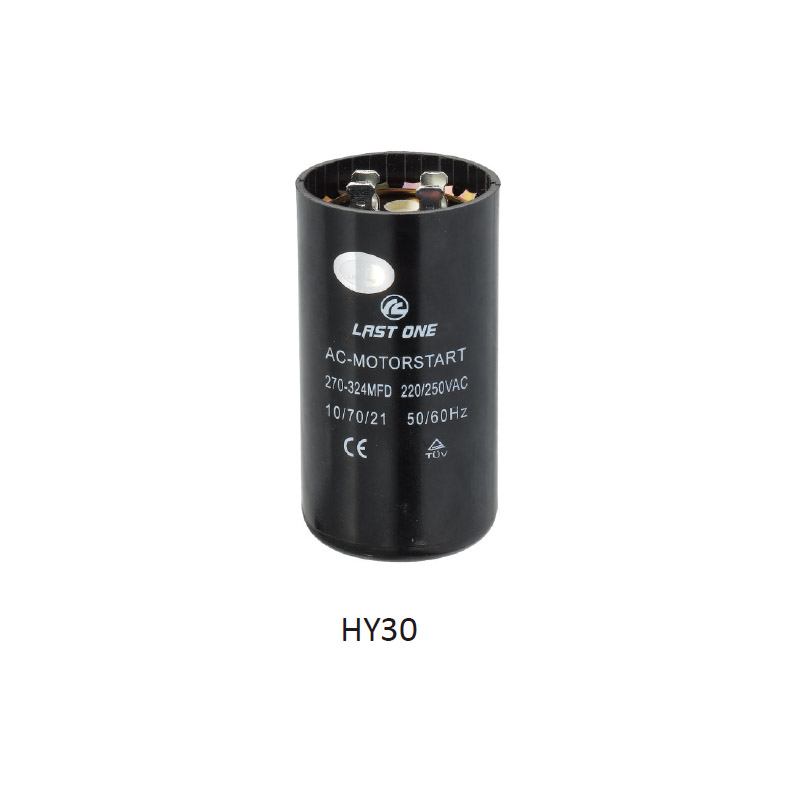
Most start capacitors use a bakelite (phenolic resin) case, which provides good insulation, moisture resistance and oil resistance. The capacitor element inside is sealed to protect the electrolyte. Standard versions use 1/4 inch quick-disconnect terminals, and many models include a built-in bleed resistor that discharges the capacitor automatically after power off.
Typical specifications include:
● Voltage range: 110–330 VAC
● Capacitance range: 21–1280 µF
● Capacitance tolerance: −0% to +20%
● Operating temperature: −40 °C to +70 °C
● Frequency: 50 / 60 Hz
● Standard: ANSI / EIA-463
Common Motor Types
● CSIR (Capacitor Start, Induction Run) — uses a start capacitor and a centrifugal switch. Common in pumps, compressors and smaller air conditioners.
● CSCR (Capacitor Start, Capacitor Run) — uses both a start capacitor and a run capacitor. Used where higher efficiency and smoother operation are required.
● PSC (Permanent Split Capacitor) — uses only a run capacitor, no start capacitor. Found in fans, blowers and small appliances.
How to Select the Correct Start Capacitor Rating
Two values must match the motor nameplate:
● Capacitance (µF) — use the µF value printed on the motor nameplate. A mismatch beyond the rated tolerance (−0% to +20%) can cause starting failure or winding damage.
● Voltage rating (VAC) — choose a voltage rating equal to or higher than the motor supply. Common ratings range from 110 VAC to 330 VAC.
Never substitute a run capacitor for a start capacitor. Run capacitors are rated at 5–50 µF, which is too low to provide the starting torque required by CSIR and CSCR motors.
Start Capacitor vs Run Capacitor
| Feature | Start Capacitor | Run Capacitor |
| Function | Provides an extra boost of torque for motor startup | Improves motor efficiency during continuous running |
| Operation Time | Active only during motor startup | Remains connected during the motor’s operation |
| Capacitance (µF) | High (typically 70–400 µF) | Lower (typically 5–50 µF) |
| Physical Size | Larger, usually cylindrical | Smaller, often oval |
| Disconnect Mechanism | Removed by relay or switch after starting | Always connected |
| Risk of Overheating | High if left in circuit too long | Designed for continuous operation |
Signs of a Failing Start Capacitor
● Motor hums but does not start
● Difficult or slow startup under load
● Motor overheats quickly
● Visible bulging, leaking or corrosion on the case
● Repeated start attempts tripping the overload protector
To test, disconnect power, discharge the capacitor, then measure capacitance with a multimeter. If the reading falls outside the nameplate tolerance, replace the capacitor.
Replacement Steps and Safety
1. Disconnect power and lock out the equipment.
2. Discharge the capacitor using a 5 W or higher resistor of 5,000–10,000 Ω across the terminals for several seconds. If the unit has a built-in bleed resistor, wait at least one minute before handling. Never short the terminals directly.
3. Remove the old capacitor and note the wire positions.
4. Install the new capacitor with matching µF and voltage rating, and reconnect wires in the same order using the 1/4 inch quick-disconnect terminals.
5. Restore power and test the motor for smooth startup and normal running.
Frequently Asked Questions
Q: Can I replace a start capacitor with a higher µF rating?
A: No. An over-rated capacitor can damage the start winding and cause overheating. Always use the µF value specified on the motor nameplate, within the rated tolerance of −0% to +20%. If you are unsure, confirm with the motor manufacturer.
Q: Why does a new start capacitor fail shortly after installation?
A: Common causes include a stuck centrifugal switch, a defective potential or current relay, insufficient voltage rating, or excessive short-cycling. Inspect the switching circuit before replacing the capacitor again.
Q: Does a start capacitor need to be discharged before testing?
A: Yes. It can hold a hazardous voltage even after power is disconnected. If the unit has a built-in bleed resistor, wait at least one minute. Otherwise, use a 5 W resistor of 5,000–10,000 Ω across the terminals to discharge it safely.
Q: Can a motor run without a start capacitor?
A: The motor may hum and fail to start, or start with reduced torque. Running without the start capacitor can overheat the start winding. PSC motors are designed to run without one; CSIR and CSCR motors cannot.
Maintenance
● Keep terminals clean and free of dust and corrosion.
● Inspect the case annually for bulging, leaking or discoloration.
● Avoid frequent start-stop cycling, which stresses the capacitor and relay.
● If a new capacitor fails, check the centrifugal switch or relay rather than replacing it again.
Post time: Nov-11-2026