


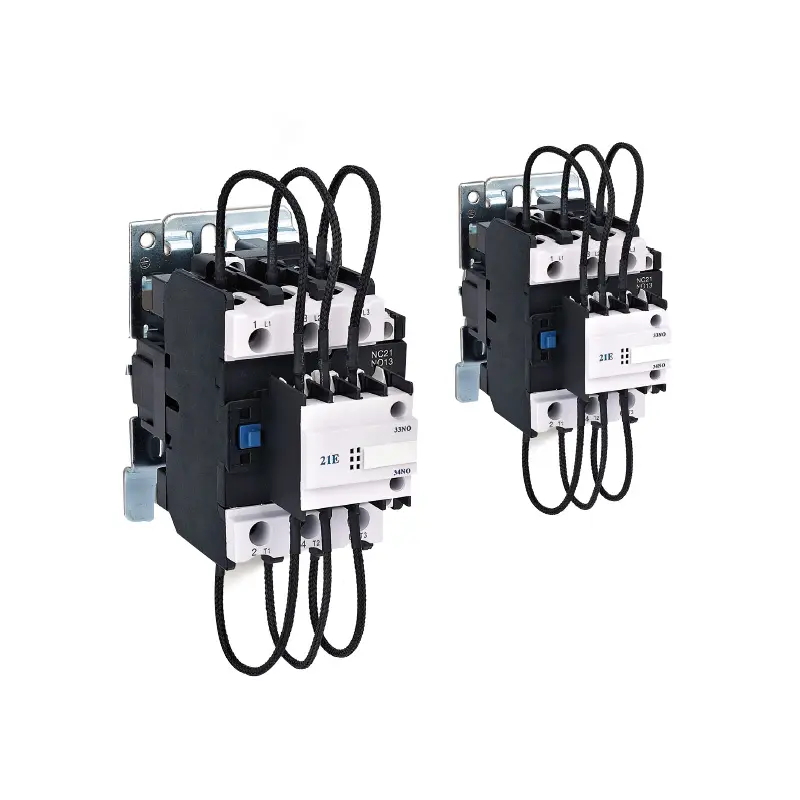
Managing power factor correction or capacitor banks often leads to the term “capacitor contactor.” So, what is its role, and why is it essential? Simply put, a capacitor duty contactor is a specialized switch for safely connecting and disconnecting capacitor banks. It is specifically engineered to handle the high inrush current that occurs when capacitors are energized, unlike standard contactors. Think of it as a robust gatekeeper that ensures smooth capacitor switching without damaging equipment or disrupting your power supply.
Why Do You Need a Dedicated Capacitor Contactor?
The capacitor duty contactor ensures safety and reliability. Standard contactors face extreme current surges when connecting capacitors, leading to arcing, contact welding, and early failure. Designed to manage this inrush, the capacitor duty contactor uses pre-charge resistors or advanced contacts to limit surge current, enabling smooth and controlled capacitor energization. This directly translates to:
◆Extended Equipment Life: By reducing stress on contacts and capacitors, it prevents frequent breakdowns.
◆Enhanced System Safety: Minimizes the risk of contact welding and catastrophic failure, protecting both personnel and other connected assets.
◆Reliable Operation: Ensures your power factor correction system performs its switching duties consistently over thousands of cycles, maintaining energy efficiency.
Key Applications and Where It’s Essential
A capacitor contactor is not an optional extra; it’s a necessity in any application involving the switching of capacitor banks for power factor correction. You will primarily find it in:
◆Industrial & Commercial Facilities: Factories, large buildings, and plants use automated capacitor banks to improve power factor, reduce utility penalties, and free up electrical capacity. The contactor is the workhorse enabling this automated switching.
◆HVAC Systems and Heavy Machinery: Equipment with large inductive motors creates lagging power factor. Local capacitor banks, switched by these dedicated contactors, are often used for correction directly at the load.
◆Renewable Energy Installations: In solar or wind farms, capacitor banks may be used for voltage support and power factor management at the point of interconnection.
Choosing the Right Capacitor Contactor for Your Needs
When selecting a contactor, the focus should be on matching it to your specific system requirements. Key specifications include operating voltage, rated current of the capacitor bank, and number of switching poles. The expected switching frequency should also be considered, whether it’s multiple times a day or less. It is recommended to consult an electrical engineer or supplier to ensure that the rated capacitor contactor you choose meets your requirements, thus ensuring reliable, long-term operation, providing peace of mind and a good return on your investment.
While it might seem like a small component in a larger system, the capacitor duty contactor plays an indispensable role. It is the critical link that ensures your investment in power quality and energy efficiency is protected, operating safely and effectively day in and day out.
Post time: Feb-02-2026