


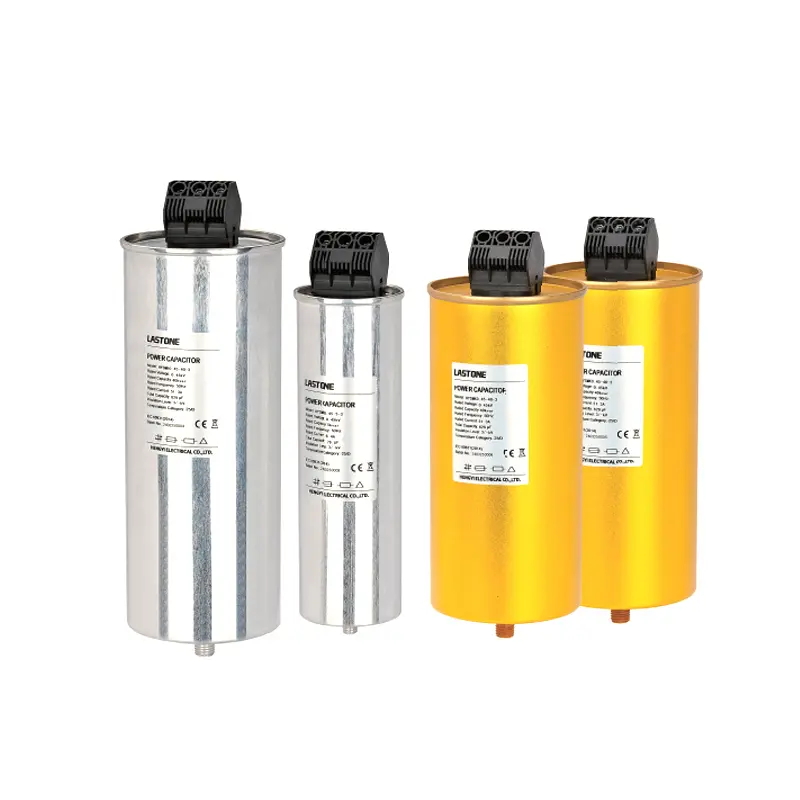
A shunt power capacitor is a passive device paralleled with inductive loads to provide local reactive power compensation. It supplies magnetizing current directly at motors, distribution boards and main switchgears, instead of drawing power from remote utility generators.
It reduces current flow in transformers and cables, releases extra system capacity for active loads, and cuts reactive power penalties on industrial and commercial electricity bills. While it does not improve motor internal efficiency, it optimizes the overall power supply path from the grid to end-use equipment.
How a Shunt Capacitor Corrects Power Factor
Induction motors, transformers and lighting ballasts consume lagging reactive power that serves no practical work yet wastes cable and transformer capacity.
Shunt capacitors generate leading current to counteract lagging inductive current at the connection point. This makes grid current nearly in phase with voltage, improves active power utilization, and minimizes reactive power circulation losses.
With no moving parts, fixed shunt capacitors operate continuously for steady-load motors and round-the-clock energized transformers. For variable and intermittent loads, capacitors are switched on and off by contactors under power factor controller regulation.
Main Application Scenarios
Shunt power capacitors deliver fast cost payback, especially for facilities with steady reactive loads and power factor penalty tariffs. Common installation locations include:
●Individual motor terminals to compensate reactive current at the source and reduce stress on starters and control components.
●Main low-voltage switchboards for centralized power factor correction of the entire plant, easy installation and maintenance.
●Distribution sub-boards to lower voltage drop in long cable runs and free up ampacity for future load growth.
●Transformer secondary sides to reduce reactive loading and enhance available active power capacity.
●HVAC chillers, water pumps, industrial fans and conveyors with long-hour stable operation, ideal for fixed capacitor compensation.
All applications help cut reactive current, lower electricity costs and maximize the value of existing electrical infrastructure.
Fixed vs Switched Compensation
Fixed capacitors feature simple structure and permanent connection, perfect for small motors and constant loads. Large motors adopt capacitor switching synchronized with motor operation to avoid over-compensation.
Automatic capacitor banks adopt multi-step switching via power factor regulators, perfectly adapting to factories with frequently starting and stopping equipment and fluctuating reactive loads. Load variability determines whether to choose fixed or switched compensation solution.
Key Selection Parameters
To ensure safe and stable operation, select capacitors according to critical technical specs:Rated voltage must be higher than system operating voltage to withstand voltage rise and grid fluctuation. Actual output kvar should be calculated based on on-site voltage, not only nameplate rating.
Built-in discharge resistors are required to release residual voltage for maintenance safety. The device must withstand high switching inrush current to avoid nuisance tripping and contact damage.
In environments with harmonic distortion from VFDs and rectifiers, detuning reactors or active filtering are necessary to protect capacitors from overheating and premature failure.
Installation & Basic Maintenance
Capacitors produce heat during operation, so good ventilation is essential. Excess ambient temperature will greatly shorten service life. Connecting cables should be oversized to handle harmonic heating, and dedicated capacitor fuses are recommended.
Install capacitors for easy visual inspection; pressure relief devices prevent case rupture from internal failure. Routine maintenance includes checking for swelling, leakage and terminal corrosion, measuring operating current, and inspecting contactor wear for timely replacement.
Conclusion
Shunt power capacitor is a mature, reliable and cost-effective power factor correction solution. Widely used in industrial sites with induction motors and transformers, it effectively reduces electricity fees, improves grid utilization and requires no complex programming or professional training.
It can be combined with automatic switching and detuning reactors to adapt to variable loads and harmonic conditions, remaining the most practical and economical choice for industrial power factor correction.
Post time: May-13-2026