


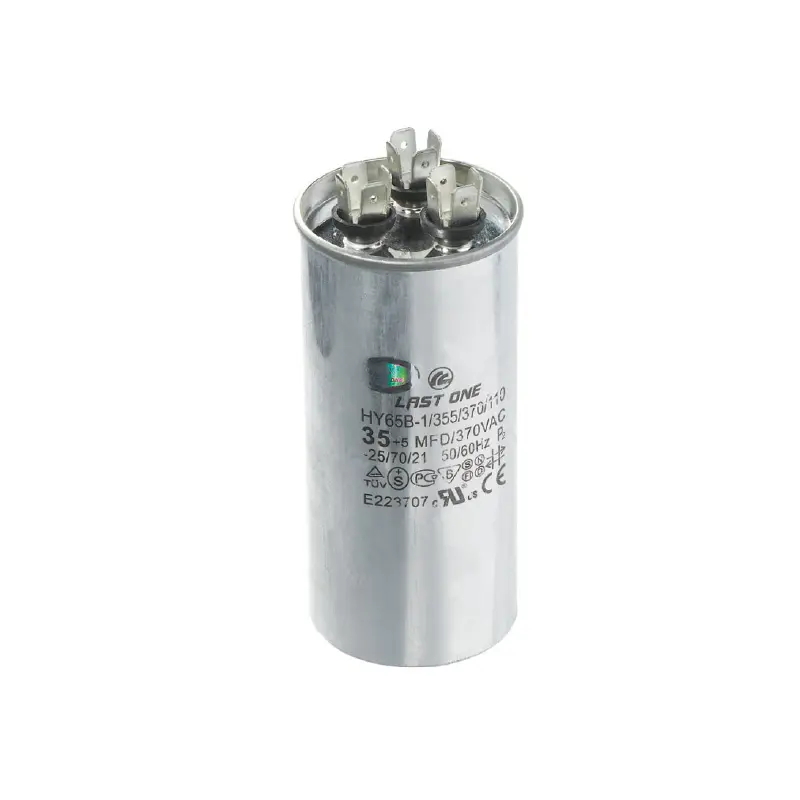
An air conditioner capacitor is a cylindrical electrical component that gives the compressor and fan motors the extra push they need to start turning, and in many systems it stays in the circuit to keep them running smoothly. When this part begins to fail, the outdoor unit often hums without starting, trips its breaker, or short cycles on thermal overload. The capacitor is one of the most common replacement parts in residential cooling service, and catching it early usually means a quick fix rather than a damaged motor.
Start Capacitors, Run Capacitors, and Dual Units
Different motors need different capacitor arrangements. A start capacitor delivers a strong but brief energy burst to overcome the motor’s resting inertia, then drops out of the circuit once the motor reaches speed. A run capacitor remains connected the entire time the motor operates, improving torque and electrical efficiency while reducing heat.
In many home outdoor units, both functions sit inside a single dual run capacitor. This part holds two separate capacitance values in one sealed housing, with three terminal connections on top: a shared common terminal, one for the compressor winding, and one for the fan motor. The compact design saves panel space, but when either internal section deteriorates the whole unit must be replaced.
Choosing a Replacement That Matches the Original
The side of every capacitor carries three pieces of information needed to select the correct replacement:
●Capacitance in microfarads:Marked as µF or MFD. A dual capacitor might read 40/5 µF, indicating 40 µF for the compressor and 5 µF for the fan. The motor manufacturer’s tolerance is usually around plus or minus five percent. A value outside that range reduces starting torque or forces the motor to draw higher running current.
●Voltage rating:Common ratings are 370V AC and 440V AC. A 440V capacitor can safely replace a 370V unit and may handle voltage spikes more comfortably, but the capacitance value must still match. A lower voltage rating than the original specification will fail prematurely.
●Case shape and mounting dimensions:The new capacitor needs to fit the existing bracket or strap inside the condenser cabinet. Measuring diameter and height avoids ordering a part that will not seat properly.
Universal or multi-tap capacitors are useful for emergency service calls, but the permanent repair is always the exact specified rating. An incorrect capacitance value may get the system running, but over a full cooling season the motor runs hotter and draws more current, slowly degrading the winding insulation.
Symptoms That Point to Capacitor Trouble
A failing air conditioner capacitor often gives visible warning before it stops working completely:
●Bulging or domed top:A healthy capacitor has flat ends. Internal heat and pressure push the aluminum top outward, and any visible rounding is reason to replace it.
●Oily residue or wet spots around the terminals:Dielectric fluid leaking past a failed seal leaves a film on the capacitor body.
●Discolored or melted terminal connections:Loose spade connectors arc under load, burning the plastic insulator and sending heat into the capacitor internals.
●Outdoor unit hums but the fan will not spin:The motor is trying to start but lacks the necessary phase shift.
●Compressor clicking on and off:The thermal overload opens after a failed start attempt, cools, resets, and the cycle repeats.
Spotting these signs during a routine spring or fall service visit prevents a callback on the first hot day when the system finally refuses to start.
Where Capacitors Work Beyond Residential AC Units
The same air conditioner capacitor design shows up across a wide range of single-phase motor applications. Common places include:
●Heat pump outdoor units:Dual capacitors handle compressor and fan circuits through defrost cycles.
●Rooftop package units:Larger commercial cabins may house separate capacitors for multiple fans and staged compressors.
●Walk-in cooler and freezer condensing units:Run capacitors support compressor efficiency during extended refrigeration cycles.
●Dehumidifiers and portable air conditioners:Smaller electrolytic or film capacitors fit compact motor frames.
●Evaporative coolers and ventilation fans:Single-phase fan motors throughout a building rely on run capacitors.
In every case, the capacitor provides the phase shift that creates the rotating magnetic field a single-phase motor needs to turn. The enclosure and terminal layout change, but the electrical job stays the same.
Safety Steps When Handling a Capacitor
A capacitor stores electrical charge even after the disconnect switch is off. The voltage can be high enough to cause injury or damage test equipment. The safe method is to discharge the stored energy through a resistor a 20,000-ohm, 5-watt resistor with insulated leads works well rather than shorting the terminals with a metal tool. A direct short creates a violent spark and can pit the terminal surface. Once a voltmeter confirms zero across the terminals, the part is safe to remove.
Taking a photo of the wiring before disconnecting anything prevents confusion during reassembly. Dual capacitors have several spade terminals, and mixing up the fan, compressor, and common wires feeds incorrect capacitance to each motor. After the new capacitor is connected, a firm push on each terminal and a gentle tug confirm the spades are seated. A loose connection arcs under load, and that arc heat can damage a new capacitor within days.
Routine Testing Keeps Surprises to a Minimum
A capacitance tester that reads microfarads is standard equipment on most HVAC service trucks. Comparing the measured value against the rating printed on the case tells a technician whether the capacitor is still within tolerance. Even a capacitor that has not yet failed visually may read low, signaling that replacement should happen soon rather than waiting for the failure. Checking capacitance as part of every condenser inspection turns a common breakdown into a scheduled parts swap.
A Small Component With a Big Effect on Reliability
The air conditioner capacitor is not an expensive part, but its failure can cascade into compressor overheating, fan motor burnout, and extended downtime during peak cooling season. It gives clear warning signs when someone looks for them a domed top, a residue trail, a terminal showing heat damage. Keeping correctly rated replacements on the truck and testing capacitance as a standard service step keeps a minor electrical part from turning into a major repair bill.
Post time: May-06-2026